RBR - News

Recent RBR News

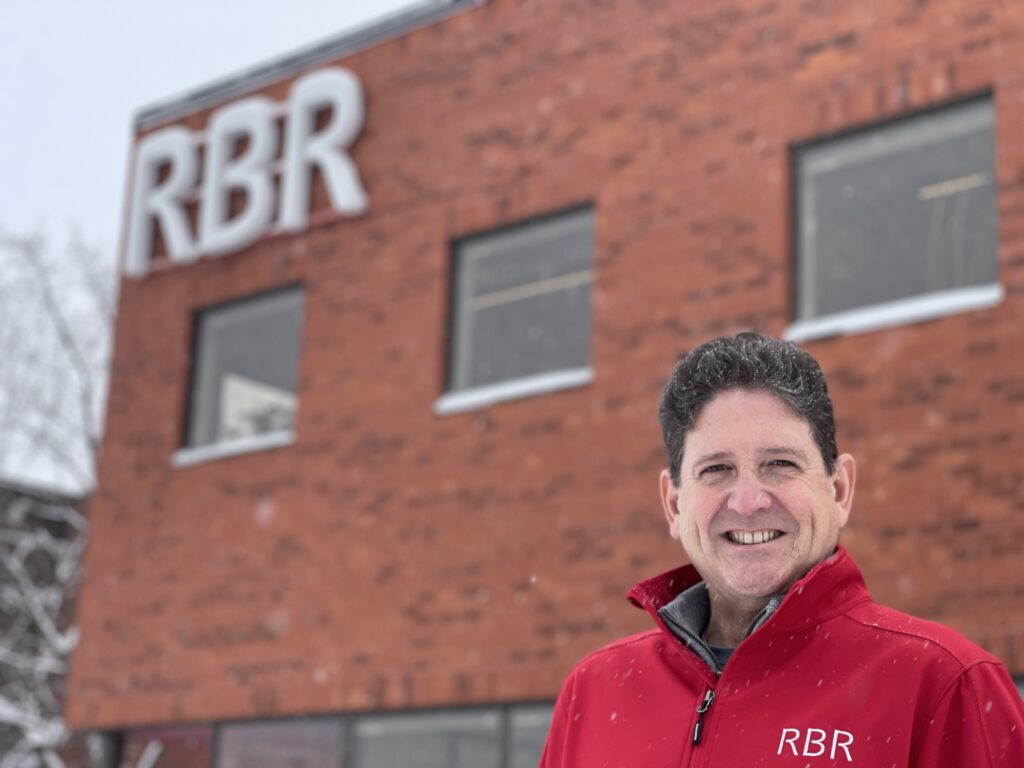
RBR Announces a New President and a Chair of the Board

RBR has steadily grown to a company of 25 people and it produces a fine range of products with excellent customer support. It has a first rank reputation internationally for its instruments which are used to measure water quality in the oceans and on land.

The RBR story has had its recent challenges: business in 2009 was the best ever. However, 2010 started with a dramatic drop in sales and the first quarter was about 30% behind expectations. By hard work and diligence on everyone’s part the company has maintained staff levels, continued product development, and the 2010 August sales surpass those of any previous year. To do all of this in the face of widespread recession and extreme currency exchange challenges is a great credit to the efforts of the staff and the sales agents worldwide.

Against this backdrop of consistent growth, quality products and the ability to weather the storms, RBR is now very pleased to announce a major change at the helm. Greg Johnson, who for two years has led the engineering developments of the company, takes over as President on September 1, 2010. Kara-Lee Golota will continues as Vice-President and Frank Johnson  assumes the role of Chair of the Board with a particular interest in fostering new activities allied to the work of RBR and instrumentation. He admits he will also be keeping an eye on the corporate pub, Irene’s, a venue of renown for live music in downtown Ottawa.

We shall ensure that this is as seamless a transition as possible. Frank has already handed over to the internal team a lot of the customer and agent support efforts that he has led for the last decade, whilst he remains available to dispense wise counsel as required. You will soon see a steady stream of exciting new products flowing from the development efforts of the last couple of years. We intend to maintain the corporate philosophy of top quality instruments together with personal customer service, and we continue to build upon the experience and foundation that has been established. RBR moves towards its fortieth year in good shape and in good hands. We trust that you will offer Greg congratulations and enthusiastic support as he takes on his new role.


CSIRO acquires an MS-310

RBR delivers yet another MS-310 Micro Salinometer, this time to the Commonwealth Scientific and Industrial Research Organisation (CSIRO) in Hobart, Australia via its Agent Metocean Services International.

Precision measurement of ocean physics is critical to understanding how the coastal marine environment or deep ocean is changing over short, medium or longer-term time-scales. Any inaccuracies in measurement impact the scientific outcomes and therefore accurate calibration is critical.  The MS-310 joins the other equipment at the extensive calibration facility at CSIRO, where they not only calibrate their own oceanographic instrumentation, but offer the service for a range of clients including state research agencies, water authorities and the Australian Antarctic Division. More details of CSIROs calibration facility can be found at http://www.csiro.au/services/OceanographicCalibrationService.html

Speaking from the calibration facility in Hobart, Facility Manager Mark Underwood commented “We are proposing to incorporate the MS-310 into a CTD calibration system. Our aim is to further automate our CTD calibration process, utilising the ratiometric properties of the MS-310 to achieve this and measure salinity in real time

The MS-310 achieves an accuracy of ±0.002 PSU and uses sample volumes of less than 20 ml.  The consumption of expensive standard seawater is greatly reduced through a standardization technique which allows the standard sample to be reused for many measurements. The innovative dual cell approach removes the need for highly stable bath temperatures since both cells are surrounded by a well stirred oil bath to ensure thermal uniformity. This ensures that sample properties needn’t be changed by warming to match the salinometer, making it ideally suited to CSIRO’s requirement to calibrate over a range of temperature.

The popularity of the MS-310 is growing with recent orders in Europe, Australia, Middle East and Asia.  RBR’s MS-310 provides oceanographers with a reliable shipboard and laboratory method to verify the performance of sophisticated modern CTD instruments.

Click here to learn more about the MS-310


Oil Spill Detection and Monitoring

RBR systems are available for crude oil detection and associated environmental monitoring in deep and coastal waters.

Fluorescence and Turbidity measurement

Crude oil has a broadband fluorescence that can be detected at low levels (well below 1ppm) with fluorometers and turbid oil emulsion plumes can be detected with light scattering turbidity sensors. We package optical sensors for both of these together with dissolved oxygen and other customer-specified sensors on the RBR XR-420/620 system with a depth rating of up to 6,000m.  Visit the Seapoint web site for performance results of the sensors - www.seapoint.com.

Inductive Conductivity measurement

The RBR inductive conductivity cell can detect oil plumes in the water column by rapidly decreasing conductivity or decreasing derived salinity values or by density anomalies.  Additionally the inductive conductivity cell can withstand deterioration produced by the crude oil, this is a huge advantage when comparing to contact cell technologies. RBR XR series loggers can be configured for real time output and interfaced to RF, GSM or Satellite modems.

Click here for more information


NOCS takes delivery of  the MS-310 Salinometer

RBR announces delivery of the MS-310 Micro Salinometer to the National Oceanography Centre, Southampton, UK.

NOCS chose the MS-310 to continuously monitor the salinity bath at their calibration facility. Furthermore the design of the MS-310 allows the NOC to develop an automation and control system to direct the MS-310 to sample automatically.

The selection of the MS-310 was made because it provides a highly accurate and stable ratio-metric determination of salinity that is temperature independent.  The innovative dual cell approach removes the need for highly stable bath temperatures since both cells are surrounded by a well stirred oil bath to ensure thermal uniformity. This ensures that sample properties needn’t be changed by warming to match the salinometer, making it ideally suited to NOCS’ requirement to calibrate over a range of temperature.

The MS-310 achieves an accuracy of ±0.002 PSU and uses sample volumes of less than 20 ml.  The consumption of expensive standard seawater is greatly reduced through a standardization technique which allows the standard sample to be reused for many measurements. The MS-310 is economical and versatile; it is small and portable and can be used in a laboratory, or in the field.

RBR is excited that the popularity of the MS-310 is growing with recent orders in Europe, Middle East and Asia as we feel that the MS-310 provides oceanographers with a reliable shipboard and laboratory method to verify the performance of sophisticated modern CTD instruments.


Click here to learn more about the MS-310


RBR releases a Fast Dissolved Oxygen profiling sensor for the XR -620 and XRX -620 loggers

The RINKO III DO sensor from JFE Alec offers an ideal complement to the XR-620CTD from RBR. The RINKO III has a short time constant of better than a second in ideal conditions. All 8 calibration constants are stored in the logger.

rinkoiiirinkoiii2


For more information, consult our XR-420/620 Multi Channel Logger product page and our Sensors page.